Epistemic Narratives Matrix™ — Applied Research
Me, You and History
Re-narrating the cover of Wilfred Thesiger's A Vanished World through the Epistemic Narratives Matrix
The Case Study
Me, You and History is the first full application of the Epistemic Narratives Matrix (ENM) — an investigative interconnected design framework for engaging with histories, artefacts, and cultural memories in ways that challenge linear, fixed interpretations. The study takes a single archival artefact and works it through every layer of the framework, documenting what a re-narration of a colonial-era photograph actually looks like in practice.
The artefact is deliberately modest: not a monument or a museum vitrine, but a book cover. On it, a photograph — and inside the photograph, a man whose name the archive does not record.
The Artefact
The book will examine the front book cover of Wilfred Thesiger's "A Vanished World", approaching it as an archival artefact open to the layering of alternative narratives within its historical trajectories. The analysis proceeds through a multimodal assemblage in which image, text, typography, and spatial composition collectively generate meaning. At the centre of this assemblage is the monochrome portrait of a Kurdish Baliki man, whose framed placement on the cover not only directs the viewer's gaze but also anchors the visual and discursive emphasis of the book.
According to the Pitt Rivers Museum at the University of Oxford, the photograph was taken between August and October 1950 in the Balakayati region — a mountainous area of present-day Iraqi Kurdistan. The title printed above the portrait declares his world vanished. The study asks: vanished for whom, according to whom, and what remains unvanished that the archive never asked about?
The Epistemic Layer — Standing In Between
The ENM requires its user to take up a third space positionality — to stand between the perspectives an artefact holds apart. In this study, that stance is not abstract: it is embodied by the author as a diaspora British Kurd, positioned between the two sides of the cover itself.
I must first acknowledge that there are multiple narratives to any historical event or artefact. Meaning that the fixed truths of my chosen artefact are not necessarily false, but rather incomplete when viewed through a pluriverse lens. To discover the other sides and their narratives, here, right at my chosen start point of the framework, I position myself as an investigator, designer and a diaspora British Kurd by standing in between the two main sides of the book cover in question.
On one side stands the photographer and author, Wilfred Thesiger, together with the publishing and archival network his acknowledgements credit — his biographer, staff at the Pitt Rivers Museum, editors, designers, and publisher — the institutional apparatus through which the cover came into being. On the other side stands the Kurdish Baliki man himself: his tribe, his region, his society and culture, and the question of how much of his world has truly vanished — and how much was simply never recorded.
First, to find or add other narratives to the portrait with the accommodating book title "A Vanished World", I will aim to create a conversation between the two main sides so that the book cover truly becomes a living, self-generating artefact of many true narratives.
What the Framework Asks
Each layer of the ENM confronts the artefact with prompt questions. The passage above responds to one of the framework's Epistemic Layer prompts:
Worked across all nine sublayers — ontological, epistemic, and relational — this questioning turns a static cover into what the study calls a living artefact: one that can hold Thesiger's narrative and the Baliki man's silenced one at the same time, without collapsing either into the other.
The Ontological Layer — Reading the Colonial Gaze, Honestly
The Ontological Layer asks what an artefact is — whose being and memory it embodies, and whose it suppresses. The study's reading of Thesiger is deliberately fair: it distinguishes his intent from his frame's effect.
A deep sense of nostalgia accompanies this ethnographic intimacy; his reflections foreground memory and aesthetic appreciation, framing a "vanished world" not through a lens of superiority but through one of mournful loss.
Nevertheless, the framing of "A Vanished World" cannot be entirely disentangled from the epistemic conditions of its author's positionality as a European moving through colonial and postcolonial landscapes. The book's cover image, featuring a Kurdish Baliki man, highlights this tension. When juxtaposed with the title, the photograph inadvertently resonates with a discourse of erasure. For Kurdish readers, whose collective history has been defined by resistance against repeated attempts at annihilation, genocide, and forced assimilation, the phrase "a vanished world" risks reinscribing a narrative of disappearance. Unless mediated by an awareness of Thesiger's intent, the title may be experienced not as nostalgic but as dismissive, an articulation that overlooks ongoing struggles for cultural and political survival and thus reveals the lingering traces of the colonial gaze within Thesiger's representational framework.
The Relational Layer — A World That Has Not Vanished
The Relational Layer produces the study's central finding — reached not by dismissing the artefact, but by the author admitting her own position in relation to it.
By practising radical honesty, I must admit that the book cover reflects more of Thesiger's worldview than the man's own. A hybrid in-between space reveals that, although Kurds have welcomed and negotiated the modernisation process into their worlds and environments, hardly any practices or elements seen in the photograph of the artefact in question have vanished. From the typical Kurdish pose, untouched natural mountainous background, to the Baliki man's clothing, weaponry, and headgear. Here, I am not a "neutral" observer; I admit how my own hybrid perspective shapes what I see. This has become a "relational intervention" because it changes the relationship between me, the artefact, and the people connected to it.
This is the reversal at the heart of the study: examined element by element — pose, landscape, clothing, headgear — the world the cover declares vanished is demonstrably alive. The "vanishing" belongs to the frame, not to the people in it.
The Re-narration
The ENM's mythopoetic practice — the Ontological Layer's poetic imagination — culminates in the study's title poem, written in the voice the archive never recorded:
Old scriptures wrote my name and engraved it
you, me and history will watch you erase it
Gently make me vanish into the fog of time
And let me disappear from your man made maps and crimes
Why It Matters
ENM aims to create a new mode of historiography. Less linear, more autopoietic, where the past is not just remembered, but re-told through the integrity of radical honesty, the openness of transparency and the symbolic power of poetry and artefacts.
This new approach aims to guide you in re-engaging with archival histories in a third space position, by standing in between two cultural identities, two sub-consciousnesses, and acknowledging an artefact's missing truths and histories.
For museums, archives, and cultural institutions, the study demonstrates a repeatable method: any collection object with contested or incomplete provenance can be taken through the same layers, producing documented alternative narratives rather than erasing existing ones. For research in decolonial and archival practice, it offers a worked example of methodology — not a theory of what re-narration might be, but 112 pages of what it is.
Read the Manuscript
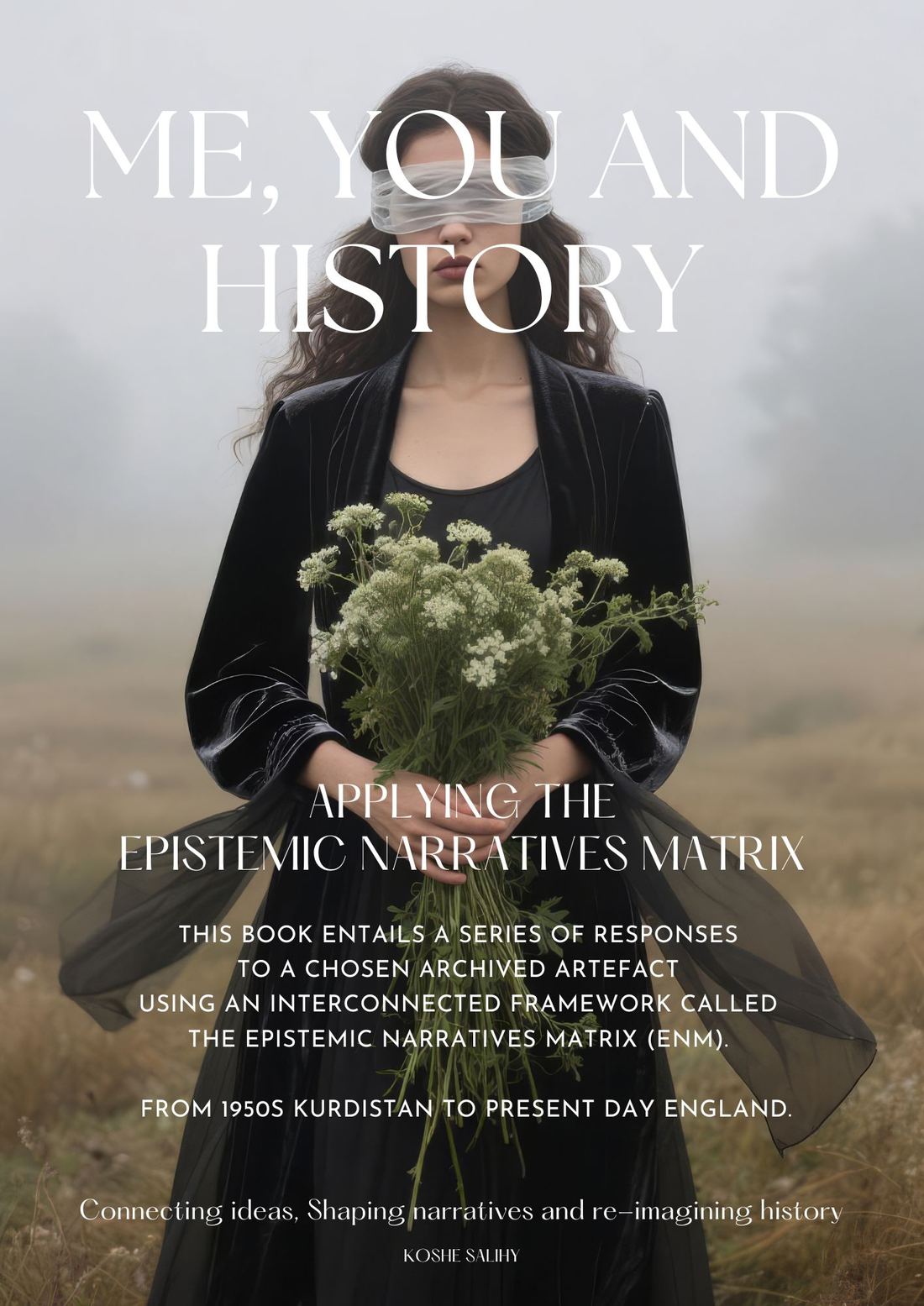
Page 1 of 10 · Front Cover
Manuscript preview · Me, You and History © Koshe Salihy · All rights reserved
Enquiries about applying the ENM to your collection, workshops, or licensing: info@enmframework.com